
Concorde
A lifelong fascination that became part of my life
Some interests develop gradually. My fascination with Concorde began in a moment.
I was 12 years old when I saw Concorde fly for the first time. I can still remember being completely captivated by the sight and sound of that extraordinary white, delta-winged aircraft passing through the sky.
I knew what Concorde was, of course, but seeing her actually fly was something altogether different. There was an elegance about her that seemed almost impossible for an aircraft capable of travelling at more than twice the speed of sound. The unmistakable shape, the sound of those four Olympus engines and the sheer spectacle of Concorde in flight left an impression on me that never went away.
From that moment, I was hooked.
What I couldn’t possibly have imagined as that 12-year-old boy was just how significant Concorde would eventually become in my own life.
The flight that never happened
As my fascination grew, so did one particular ambition.
I wanted to fly on Concorde.
It became the ultimate item on my bucket list and I had set my heart on experiencing a flight to celebrate my 18th birthday. To me, there could scarcely have been a more exciting way of marking that milestone than finally travelling aboard the aircraft that had captivated me since childhood.
I assumed I had time.
Then, in 2003, British Airways and Air France announced that Concorde would be permanently retired.
I was devastated.
Concorde’s final commercial services took place on 24 October 2003 – ironically, my birthday – exactly one year before I would turn 18. Her final flight followed a month later.
Suddenly, the experience I had spent my teenage years dreaming about had disappeared before I was ever old enough to realise it.
I would never fly on Concorde.
For somebody still in his teens, that might seem an insignificant disappointment in the greater scheme of things. But Concorde had captured my imagination in a way very little else had, and watching her disappear from the skies left me with an overwhelming feeling that something extraordinary was being lost.
Perhaps that disappointment also explains some of what happened next.
Rather than allowing Concorde simply to become something I had nearly experienced, I became increasingly interested in what would happen to the aircraft after retirement – and whether her story really had to end there.


Refusing to let the story end
In April 2004, aged just 17, I joined the Save Concorde Group (SCG) as a junior member of its campaign team.
I subsequently became the Group’s PR Manager, before being appointed Vice Chairman in 2008 and ultimately Chairman in late 2009 – a position I continue to hold today.
Our original ambition was deliberately bold: to explore every credible possibility of seeing Concorde operate again and, ultimately, whether a technically, financially and regulatorily viable route might exist to return an aircraft to the skies in a limited heritage capacity.
We were never under any illusion about the scale of that challenge. Concorde is an immensely complex aircraft and returning one to flight after retirement presents formidable engineering, certification and financial obstacles.
But we believed an aircraft representing such an extraordinary achievement deserved people prepared to ask the questions rather than simply accept that nothing further could ever be achieved.
Alongside that ambition, the preservation and protection of the surviving Concorde airframes has always been fundamental to our work.
Over more than two decades, I have campaigned on issues affecting individual aircraft, worked alongside people possessing first-hand technical knowledge of Concorde and helped maintain public and media attention around the importance of protecting her legacy.
The irony has never been lost on me.
I never achieved my childhood dream of becoming a passenger on Concorde. Instead, that 12-year-old boy who once simply looked up in amazement would go on to spend more than two decades campaigning for her preservation.
In a strange way, the flight I never got to take became the beginning of a completely different journey.
Reuniting the Anglo-French spirit
One of the most exciting chapters of that journey came through our collaboration with the French Olympus 593 organisation.
Concorde herself only existed because Britain and France combined their expertise, resources and determination to achieve something neither nation could realistically have accomplished alone. There was therefore something particularly appropriate about British and French enthusiasts and former Concorde professionals coming together again after retirement.
In 2010, technical work was undertaken on Air France Concorde F-BTSD – Sierra Delta at the Musée de l’Air et de l’Espace at Le Bourget, Paris, with the condition of her Rolls-Royce/Snecma Olympus 593 engines among the areas examined.
The project explored the possibilities of returning systems to operation and ultimately seeing Concorde move under her own power again.
For me personally, it was extraordinary.
Only a few years earlier I had been a teenager watching Concorde disappear from the skies. I was now in France, working alongside people with genuine first-hand engineering knowledge of the aircraft as serious technical investigation was once again being undertaken.
It reinforced something I have always believed about preservation: protecting an historic aircraft should, wherever possible, mean preserving not only the physical machine but also the knowledge, skills and human experience behind it.

Protecting the surviving Concordes
My involvement has never been solely about the possibility of seeing Concorde fly again.
An equally important priority has been ensuring that the surviving aircraft are protected and displayed in a manner befitting their historical importance.
Over the years, SCG has campaigned particularly strongly around British Airways aircraft G-BOAF – Alpha Foxtrot, the last Concorde ever built and the last to fly, and G-BOAB – Alpha Bravo, which remains at Heathrow.
In 2010, amid concerns about the future public accessibility of Alpha Foxtrot at Filton, we launched our Save Our Speedbird campaign and organised a public meeting in Bristol to bring supporters and interested organisations together.
Alpha Foxtrot ultimately became the magnificent centrepiece of Aerospace Bristol, appropriately preserved at Filton – the place where every British Concorde was born.
Alpha Bravo’s story remains rather different.
Unlike her sisters, G-BOAB never returned to passenger service following Concorde’s grounding in 2000 and consequently took no part in the farewell flights of 2003. She remains at Heathrow, the airport which was once Concorde’s operational home.
For many years I have advocated for Alpha Bravo to have an appropriate permanent future at Heathrow, accessible to the public while preserving the integrity of this historically important airframe.
I remain passionate about securing a fitting future for her.
Concorde should not merely survive. She should be preserved in a way that allows future generations to understand what she represented.
The people Concorde brought into my life
Perhaps one of the greatest privileges of my involvement with Concorde has been the people I have met along the way.
As a boy, the pilots, engineers and personalities associated with Concorde belonged to a world that seemed unimaginably distant. Through my work with the Save Concorde Group, many of those people subsequently became colleagues, supporters, acquaintances and, in some cases, friends.
I have had the privilege of meeting and working with former Concorde pilots, flight engineers, cabin crew, engineers and others who actually designed, built, maintained and operated the aircraft.
My involvement has also brought me into contact with a number of prominent figures connected with aviation and Concorde, including Sir Richard Branson, as well as people whose own lives became synonymous with the aircraft.
One of those relationships has become particularly special to me.


Fred Finn – the World’s Most Travelled Man
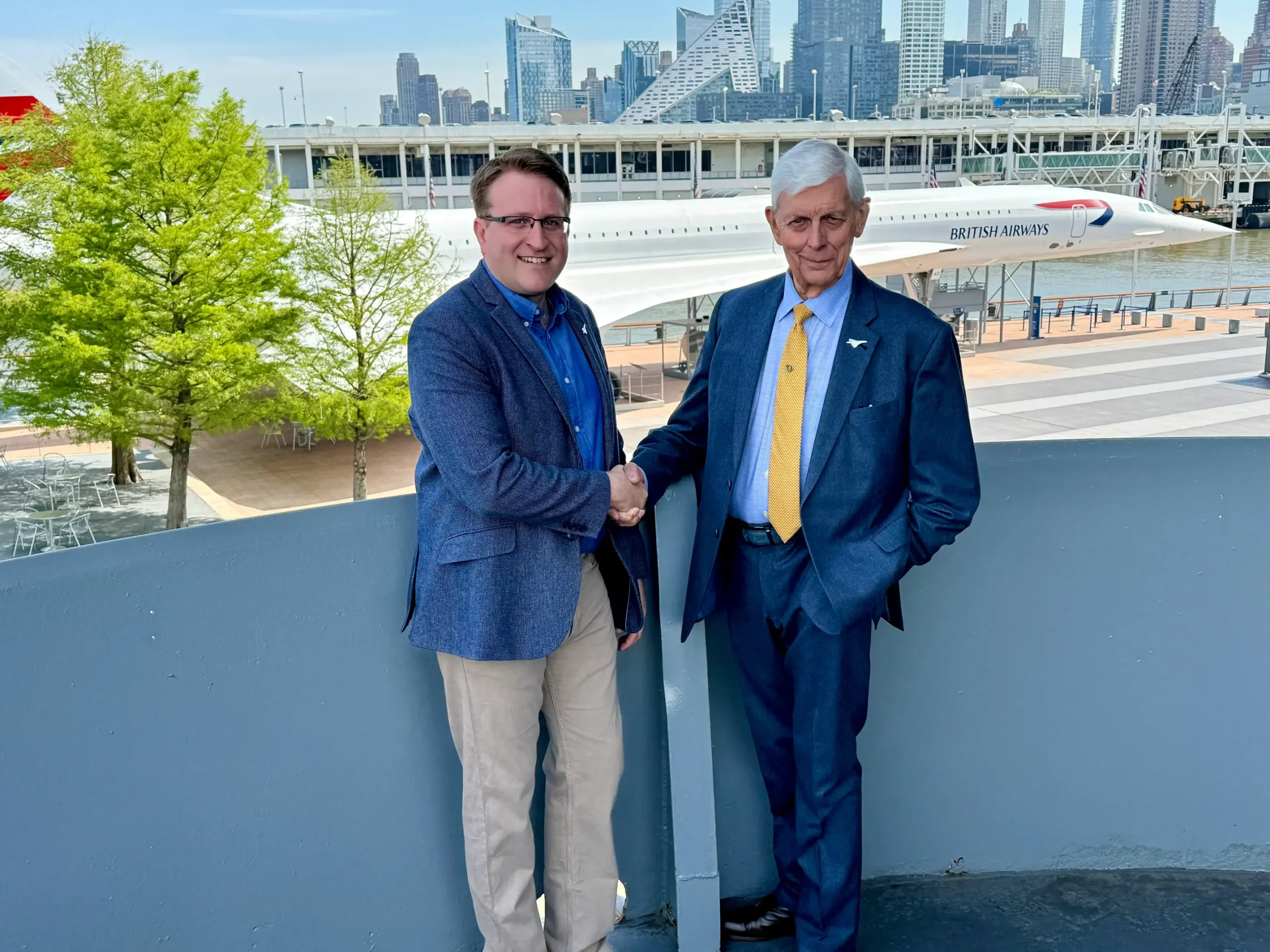
Through Concorde I came to know Fred Finn, internationally recognised as the World’s Most Travelled Man and one of Concorde’s most famous passengers.
Fred’s association with the aircraft is extraordinary. He flew on Concorde hundreds of times and experienced supersonic passenger travel to an extent very few people ever did.
What began through our mutual connection with Concorde developed over the years into a close personal friendship and professional association.
We have attended Concorde events together, travelled together and shared countless conversations and stories about an aircraft which occupies such an important place in both our lives.
Knowing Fred has also given me a wonderfully different perspective on Concorde. My own great regret is that I never got to experience a single flight; Fred experienced her more than virtually anyone else.
Through him I have been able to hear first-hand what Concorde was like not simply as an extraordinary piece of engineering, but as a means of travel that genuinely changed the geography of the world for those fortunate enough to use it.
Our friendship is one of many things Concorde has unexpectedly brought into my life – and certainly something the 12-year-old boy who first watched her fly could never have foreseen.
Concorde and the media
An unexpected but significant part of my work with the Save Concorde Group has been becoming a regular media commentator on Concorde, supersonic aviation and the continuing efforts to preserve her legacy.
Over more than two decades, I have undertaken in excess of 100 media interviews across television, radio, newspapers and other publications in the UK and internationally.
My broadcasting work relating to Concorde has included appearances on BBC News and Sky News, together with interviews across every BBC local radio station in the UK. I have also been interviewed and quoted extensively by regional, national and international newspapers and publications.
The subjects have been as varied as Concorde’s story itself – from the preservation and condition of individual aircraft and proposals for their future, to engineering initiatives, significant anniversaries, supersonic travel and the enduring public fascination with Concorde more than two decades after her retirement.
I have also had the privilege of appearing alongside people who were part of Concorde’s operational history, including former British Airways Chief Concorde Pilot Captain Mike Bannister, bringing together my perspective as a preservation campaigner with the first-hand experiences of those who actually flew and operated the aircraft.
Media engagement has always been an important part of our work. Concorde’s continued preservation depends in no small part upon maintaining public interest in her story, and I have always regarded communicating that story as one of my responsibilities as Chairman of the Save Concorde Group.
What began with speaking to the media on behalf of a campaign I joined as a teenager has consequently developed into more than twenty years of broadcast and press experience – often discussing the very aircraft I once simply stood and watched in amazement as a 12-year-old boy.


Chasing Concorde in New York
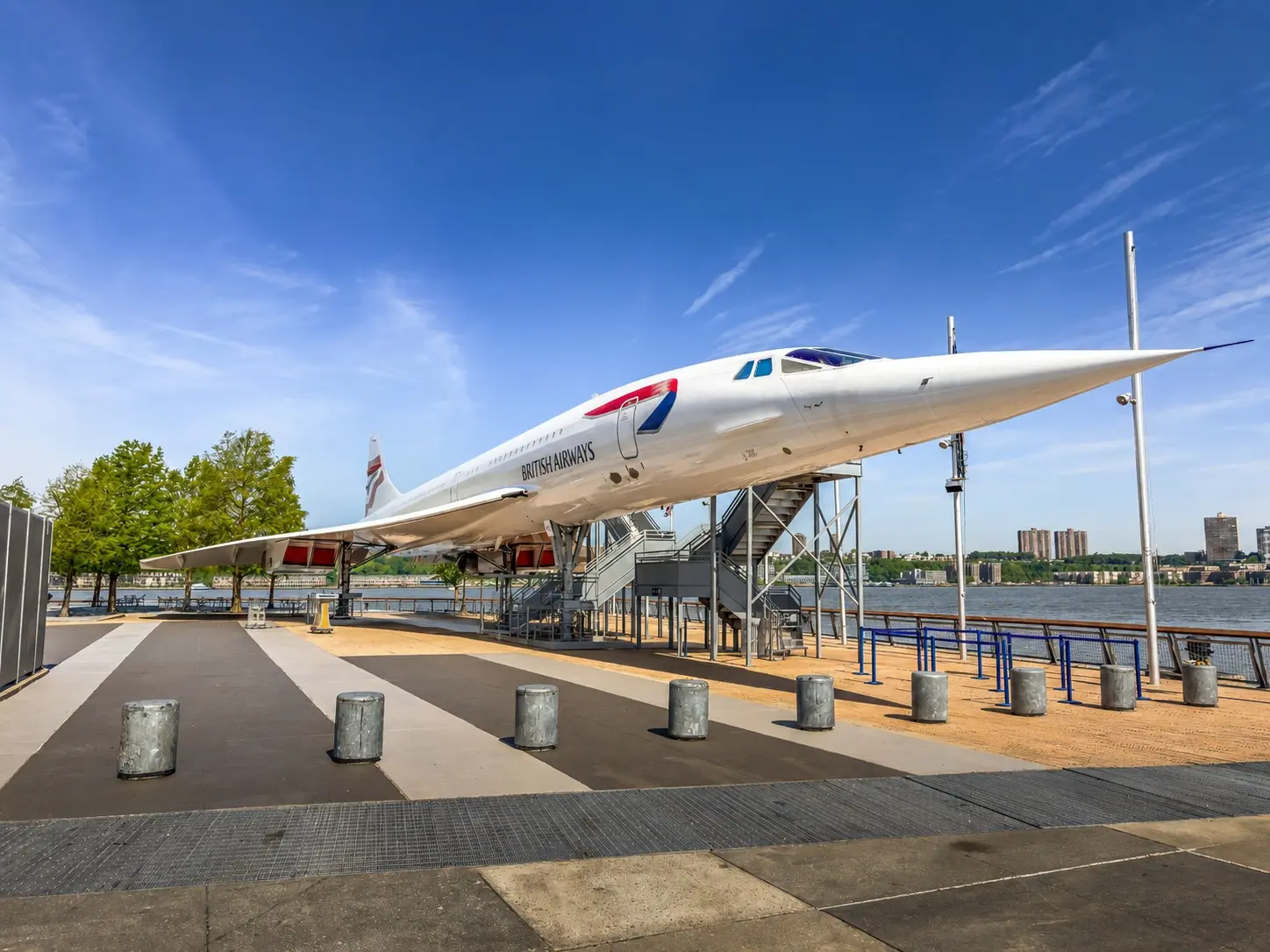
More than twenty years after first seeing Concorde fly, one of my most memorable experiences came in 2024 with British Airways Concorde G-BOAD – Alpha Delta in New York.
Alpha Delta has a particularly special connection for me. I remember seeing this very aircraft fly over my home in May 2002, when she was rehearsing with the Red Arrows ahead of their spectacular flypast for Queen Elizabeth II’s Golden Jubilee.
Twenty-two years later, I travelled to New York as Alpha Delta prepared to return to the Intrepid Museum following an extensive restoration programme at the Brooklyn Navy Yard.
Armed with my camera, I spent an unforgettable day effectively chasing Concorde around New York as she travelled by barge.
Watching her pass some of the world’s most recognisable landmarks – the Manhattan skyline, Brooklyn Bridge, One World Trade Center and the Statue of Liberty – was extraordinary.
There was also something wonderfully ironic about watching one of the fastest passenger aircraft ever created undertake what must have been one of the slowest journeys of her existence.
The following morning, I watched Alpha Delta make her final journey up the Hudson before being returned to the Intrepid, and I was subsequently invited back as a guest of the museum for her official unveiling.
My photographs and eyewitness account were later published in Mach 2, the Concorde magazine, with one of my photographs also appearing on the front cover.
It was another of those moments when I found myself wondering what that 12-year-old boy would have made of it all.
More than an aircraft
Concorde’s enduring appeal lies in the fact that she transcended aviation.
She represented an era when technological progress seemed almost limitless – when Britain and France were prepared to take an extraordinarily ambitious idea and turn it into reality.
Concorde was engineering, diplomacy, elegance, glamour and sheer human ambition wrapped into one unmistakable silhouette.
Designed decades before today’s sophisticated computer technology, she carried fare-paying passengers at more than Mach 2, cruising at altitudes approaching 60,000 feet and crossing the Atlantic in little more than three hours.
For 27 years, she made the extraordinary seem routine.
But preserving Concorde is about more than preserving aeroplanes.
It is also about preserving the memories and expertise of the thousands of people who conceived, designed, built, maintained, crewed and flew her. As the years pass, protecting that human story becomes every bit as important as protecting the airframes themselves.
Future generations should understand not only what Concorde did, but how extraordinary it was that people made it possible at all.

More than twenty years later
More than two decades have passed since I first became involved with the Save Concorde Group, and inevitably the nature of our work has evolved.
I continue to serve as Chairman of the Save Concorde Group, advocating for the preservation of the surviving aircraft and helping to keep alive the knowledge, memories and ambition that Concorde represents.
Whether Concorde herself could ever return to the skies is ultimately dependent upon enormous technical, regulatory and financial considerations. But whatever the future holds, I remain as determined as ever that her story should be properly preserved.
Concorde has given me far more than the flight I once dreamed of taking.
She has taken me to extraordinary places. She has introduced me to remarkable people. She has given me friendships, experiences and memories I would otherwise never have had.
And more than a quarter of a century after seeing her fly for the first time, part of me is still that 12-year-old boy looking up at the sky in complete amazement.
Perhaps that is the real magic of Concorde.
She didn’t merely show us how quickly we could cross the world.
She showed us how far human ambition could take us.